|
||||||||||||||||||||||||||||||||||||||||||||||
|













































|
|
|
|
|
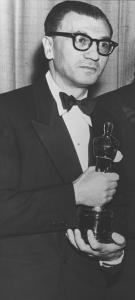
Bronislau Kaper Bronislau Kaper was born in Warsaw, Poland on February 5, probably in 1902, although Kaper wasn't positive of the year because his birth certificate
had undergone a number of changes. He started playing piano at age six, and was soon performing standard repertoire and composing. After combining a course in law at the University of Warsaw with piano
and theory studies at the Warsaw Conservatory of Music, he began to focus on music and moved to Berlin. By 1933 he had written concert music and composed popular songs for many films in France, England,
Poland, and Germany, some written under pseudonyms to avoid the growing tide of anti-semitism. A few of his European film credits are: Chant Du Destin, Die Grosse Attraktion, and Nuits Moscovites. After moving to Paris, he was “discovered” by Louis B. Mayer, who had heard Kaper's song “Ninon,” and in 1936 the composer went to Hollywood, signing a series of contracts with MGM and writing for that studio until the early 1960s. Because he was known primarily as a songwriter, he was restricted to writing songs during his first four years at MGM, among them “All God's Chillun Got Rhythm,” “Cosi Cosa,” “San Francisco,” and “You're All I Need.” In 1940 he began composing background scores for movies, and his approximately 100 American film scores include: Auntie Mame, Bataan, Bewitched, The Brothers Karamazov, The Chocolate Soldier, The Glass Slipper, Green Dolphin Street, Her Twelve Men, Home From The Hill, Invitation, The Red Badge Of Courage, The Stranger, That Forsyte Woman, and Them! In 1953 Kaper won the Academy Award for Lili, which contained the song “Hi-Lili, Hi-Lo,” and he was nominated for an Academy Award on three other occasions. Some of the composer's own favorite scores were for Lord Jim, Mutiny On The Bounty, and The Swan, and he wrote “Polonaise” for the Broadway stage. He was a member of the board of governors of the Academy of Motion Picture Arts and Sciences and a board member of the Los Angeles Philharmonic Society. Among his hobbies were fencing and watching prizefights. Bronislau Kaper died on April 25, 1983. |
|||
|
Contents of this website Copyright © 1996 - © 2020 Monstrous Movie Music. |
|||